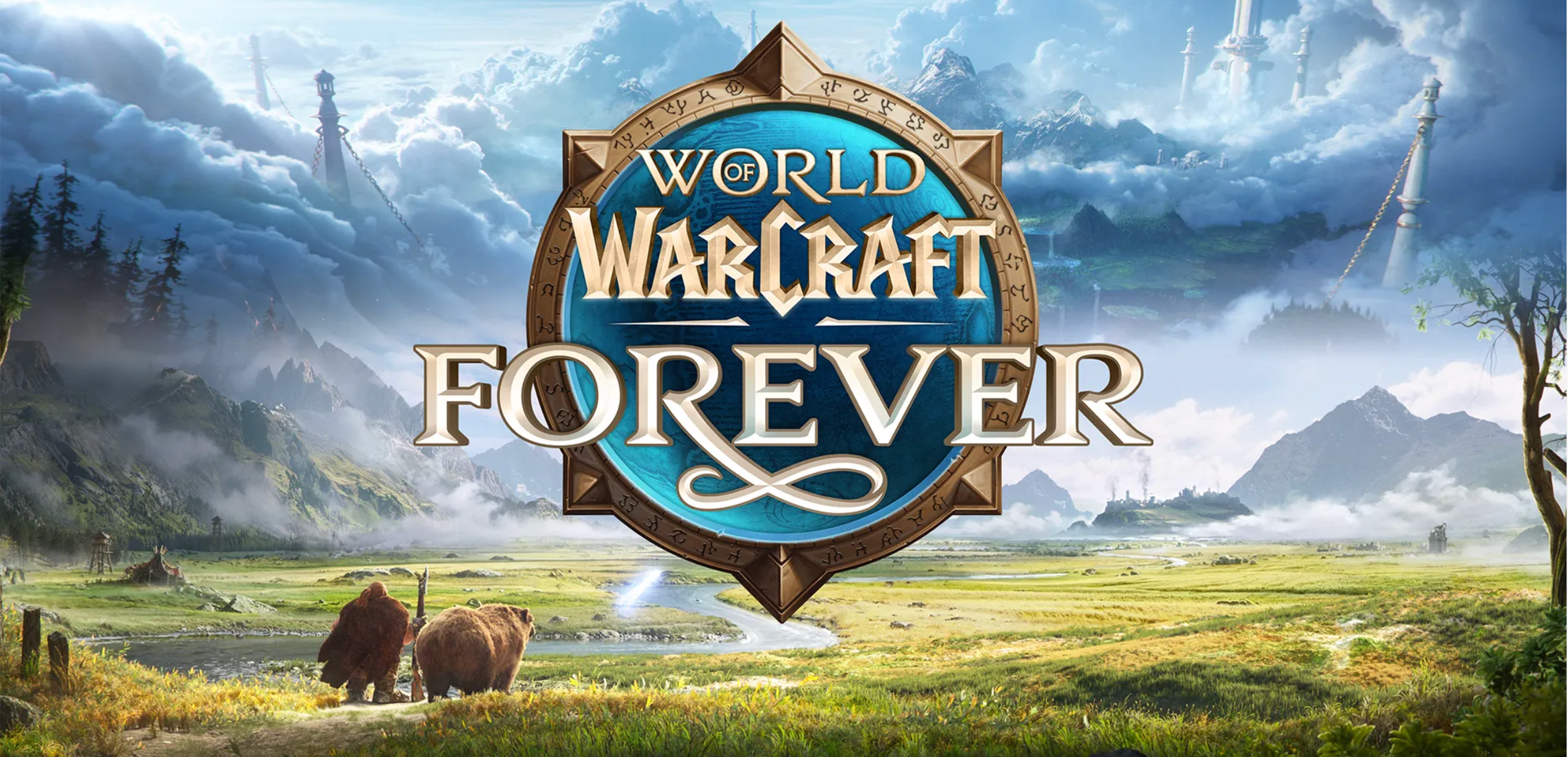
For years, "Classic Plus" was a fan term Blizzard refused to use. That ended when Blizzard president Johanna Faries closed the BlizzCon 2026 opening ceremony with a cinematic of a dwarf and his bear crossing old Azeroth, and then told the crowd flat out: "this is Classic Plus." The official name is World of Warcraft: Forever, it launches on November 4, 2026, and a beta opens on September 17.
The obvious question for anyone who already has a level 60 somewhere in the Classic ecosystem: what is this, exactly, and how is it different from the four or five versions of Classic that already exist? Short version: every existing Classic version replays WoW's history. Forever rewrites it.
The Classic family tree, as of today
Before Forever, a WoW subscription already got you into a surprising number of vanilla-derived games, all sharing the same 1.12-era foundation:
Notice the pattern. Every one of these is either a museum piece (Era, Hardcore), a time-limited experiment (SoD), or a train that leaves vanilla behind on a schedule (Anniversary, progression). None of them is a place where vanilla Azeroth grows. That's the gap Forever is built to fill.
|
Version |
What it is |
Where it's going |
|
Classic Era |
The 2019 re-release of vanilla, level 60, no expansion content |
Nowhere. Permanent, frozen |
|
Hardcore |
Classic Era with permanent death |
Permanent, frozen |
|
Season of Discovery |
Vanilla with Rune Engraving, reworked classes, remixed dungeons and raids |
Seasonal; concluded with Phase 8 (Scarlet Enclave), realms still up |
|
Anniversary realms |
A 2024 "fresh" restart of Classic |
Already moved on to Burning Crusade Classic Anniversary (Black Temple is live, Sunwell is next). Hardcore Anniversary stays in vanilla |
|
Progression realms |
The original 2019 servers that kept marching through the expansions |
Currently Mists of Pandaria Classic, in its final stretch |
Forever vs. Classic Era and Anniversary: frozen vs. growing
Classic Era is vanilla as it was in patch 1.12, kept intact on purpose. Forever starts from a similar place - the level cap is 60, there's no flying, no level scaling, 40-yard-pull danger is the point - but then it keeps adding things vanilla never had.
At launch that means three new zones (Mount Hyjal as an endgame leveling area, Zephras Isle as a new 1-12 starting zone, and the Riverglades, with Shen'dralas also named in the deep-dive panel), several original zones expanded with new geometry and hubs, Dalaran finally opening its gates, and Nordrassil becoming somewhere you can actually go. Blizzard is quoting more than 1,000 new quests spread across the whole 1-60 bracket, nine new dungeons (Halls of Thanes under Ironforge, the ruins of Lordaeron, Alcaz Island Prison and the Drowned City among them), a large outdoor dungeon called Krol'dok Stronghold, and two new raids - Hyjal Summit and Barrow Deeps.
Anniversary realms are the other side of the comparison. They gave players a fresh economy and a fresh race to 60, but on a clock: the PvE and PvP Anniversary realms are already in Outland. Forever has no such clock. Blizzard's own framing is that this is a permanent home, and the team said on stage it is not planning around level-cap increases that invalidate what you've earned. Professions you level are supposed to keep mattering indefinitely.
Forever vs. Season of Discovery: the closest relative, and the biggest difference
If you played SoD, Forever will feel like the sequel, and Blizzard basically admitted as much. In the deep-dive panel, Ion Hazzikostas described Season of Discovery as an experiment designed to test how much change the game and the community could absorb, and said the decision to build Forever for real came in mid-2024.
The differences are still substantial:
- Seasonal vs. permanent. SoD was always going to end; it has. Forever is being sold as the version that stays.
- Runes vs. redesigned classes. SoD bolted new abilities onto vanilla classes through the Rune Engraving system. Forever reworks the classes themselves: updated class design, new skills, revised talent trees, a racial pass (Dwarves hit beasts harder, Undead spells can leech health), and combos vanilla never allowed - Undead Paladin, Dwarf Shaman, Orc Mage.
- Remixed content vs. new content. SoD's headline moments were old places repurposed (Blackfathom Deeps as a raid). Forever ships zones, dungeons and raids that didn't exist before, and a new playable race.
- Same timeline vs. new timeline. SoD never pretended to change the story. Forever is set in year one of vanilla - after the Warcraft III Forsaken Kingdom campaign, before Molten Core - and Blizzard says the future from that point is untold. Expect stories that "couldn't happen" in the canon timeline.
Forever vs. Hardcore
This one's simple: Blizzard confirmed a Hardcore mode is coming to Forever as well. Whether it launches on day one wasn't stated. If you're a Hardcore player, the interesting question is whether a redesigned talent system and new dungeons make the permanent death run more or less forgiving - nobody knows yet.
Forever vs. the progression track (TBC Anniversary, MoP Classic)
The progression realms are the philosophical opposite of Forever. They exist to move forward through Blizzard's actual history: Outland, Northrend, Pandaria, eventually whatever comes after. Forever explicitly rejects that structure. Faries pitched it as a game where the journey matters more than the destination, with the world itself as the main character rather than a big heroic plot.
The practical expression of that: raids in Forever are 10- and 20-player, not 40. There's no flying because Blizzard wants Azeroth to remain something you cross on the ground. There's no level scaling because the danger gradient of the world is part of the design. And there's a stated commitment to not resetting your gear every couple of years.
The stuff only Forever version has
Some of Forever's additions have no equivalent anywhere in Classic:
- The Skyborne, a new elven race from Zephras Isle that can join either faction. They bring Shaman to the Alliance, Mage to the Horde, and Druid to both, with new forms.
- Camping - portable crafting stations that give skill buffs when several players use them together.
- A Legacy System that rewards repeated 1-60 journeys with perks for your alts.
- Account-wide perks, new reputations and new profession content.
- Opt-in transmog - you decide whether you see it on yourself and others.
- An SD/HD toggle for character and NPC models, plus updated world lighting.
- Gamepad support
- Darkspear Islands, a new capture-point battleground.
Anniversary realms added a group finder and some quality-of-life fixes. Forever is a different order of change.
What's the same
The skeleton is still vanilla. Level 60. Talent trees, not talent rows. A world you walk through. Dungeons and quests that expect you to talk to people. Blizzard's first design pillar is literally that the world should still feel like Classic. If you disliked vanilla's pace, Forever won't change your mind.
It also lives under the same subscription: from November 4, an active WoW subscription or game time includes Forever alongside modern WoW and the other Classic versions. Blizzard has said it will run as a third pillar next to modern and Classic, so Era, Hardcore and the Anniversary realms aren't going anywhere because of it.
Bottom line
Classic Era is for people who want vanilla exactly as it was. Anniversary and the progression realms are for people who want to relive the expansions in order. Season of Discovery was for people who wanted vanilla shaken up for a while. Forever is Blizzard's answer to the question the community has been asking since 2019: what if the game had never left the original Azeroth, and the team had just kept building.